




























Enjoy your Lightswing® right away
So you have time to think about it
We'll prepare your order the same day
Are you unsure which pendant light is suitable for the Lightswing®? Or are you looking for a light that you can easily reposition without having to reinstall it?
Not every pendant light is compatible with the Lightswing®. The good news is that it’s easy to check whether your current light is suitable.
In this blog, we guide you through exactly what to look for when choosing a pendant light for the Lightswing®, including weight, connection, and type of light.
A pendant light is suitable for the Lightswing® if it meets three key requirements: the correct weight, one power cable, and no built-in electronics.
Each Lightswing® has a maximum load capacity, which varies by model:
For linear or heavier lighting, there is a separate solution:
This model is specifically designed for bar lights or linear pendant lights and is often used above long dining tables or kitchen islands.
Why this matters:
Each Lightswing® is designed to support a specific maximum weight. Exceeding this limit can affect both the stability and safety of the system.
With the 110 cm version, the lamp is positioned further away from the pivot point. This creates more leverage, which is why the maximum load capacity is lower.
For additional stability, especially when using the full length, it is recommended to use the levelling foot. This helps distribute the weight and keeps the Lightswing® stable during use.
Tip: Always check the weight of your light in the product specifications.
The Lightswing® uses one central connection via the Quick Release.
This means that a suitable pendant light must have one power cable. Lights with multiple cables or separate connection points are not compatible.
Does your light include a decorative chain or an additional support cable?
That’s not a problem, as long as there is only one electrical cable.
Pendant lights with a built-in dimmer or transformer inside the ceiling canopy are not compatible with the Lightswing®.
Since the Lightswing® replaces the original ceiling canopy, there is no space for these components.
If you would like dimmable lighting, it is best to use a wall dimmer instead.
Looking for inspiration? Many types of pendant lights work well with the Lightswing®, as long as they meet the requirements for weight and connection.
Glass pendant lights
Create an open, airy look with even light distribution. Clear glass creates a spacious feel, while smoked or frosted glass softens the light.
Fabric pendant lights
Provide soft, diffused lighting and create a warm, cozy atmosphere. Ideal for living rooms and bedrooms.
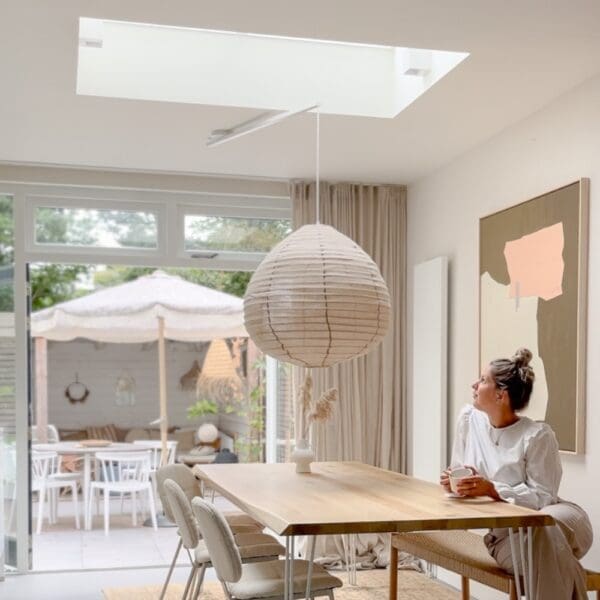
Paper pendant lights
Lightweight and perfect for minimalist or Scandinavian interiors. They offer soft, even lighting.
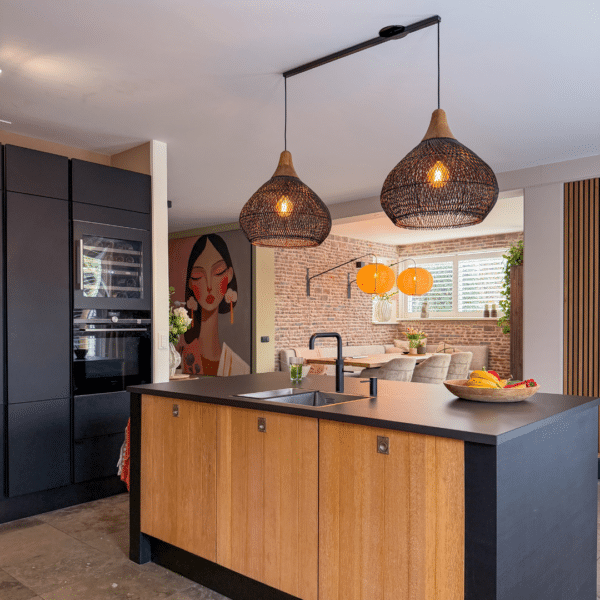
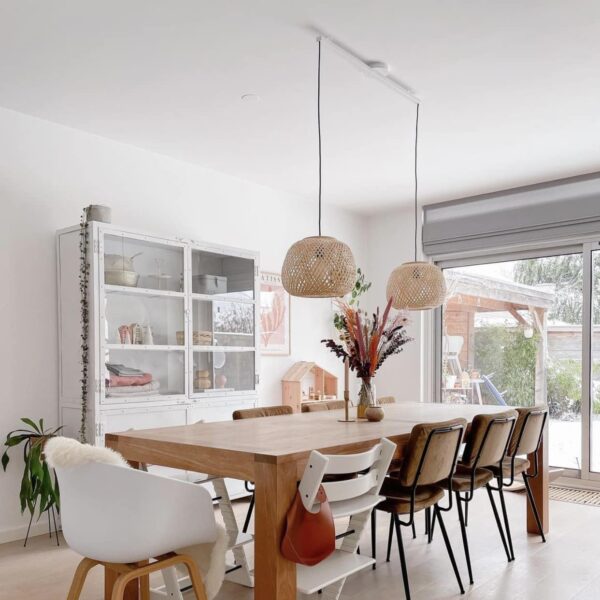
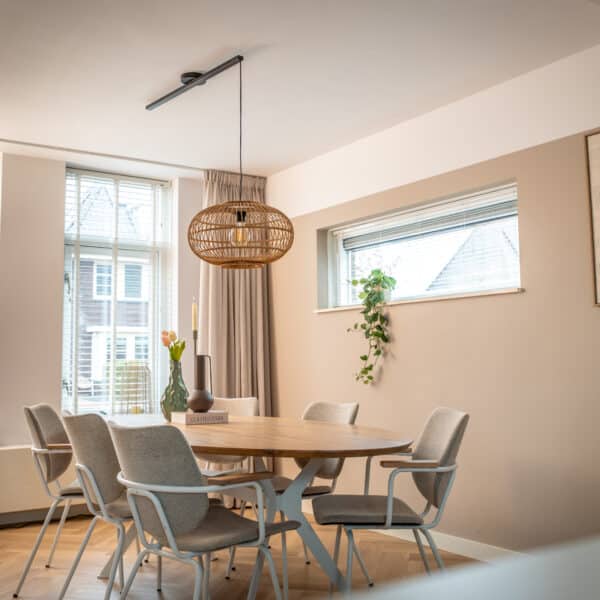
Rattan or bamboo pendant lights
Add a natural look and create a playful light pattern thanks to their open structure.
Metal pendant lights
Work well in modern or industrial interiors. Always check the weight, especially for larger or solid designs.
Would you like to switch between pendant lights without any hassle? The Quick Release makes it easy.
With the Quick Release, you can attach a pendant light to the Lightswing® in just a few seconds, and remove it just as easily, without tools or complicated installation.
You can also purchase multiple Quick Releases separately and attach them to different lights. This allows you to switch effortlessly between styles, depending on the season or your interior.
For example, choose a light, airy design in summer and a warmer, more atmospheric light in winter. With just one click, you can completely change the look of your space without having to reinstall anything.
Choosing a suitable pendant light for the Lightswing® is straightforward when you keep a few key factors in mind. By checking the weight, connection, and presence of built-in electronics, you can be sure your light is both safe and fully compatible.
With the Quick Release, switching between lamps becomes even easier, giving you maximum flexibility to adapt your lighting to your space in seconds.